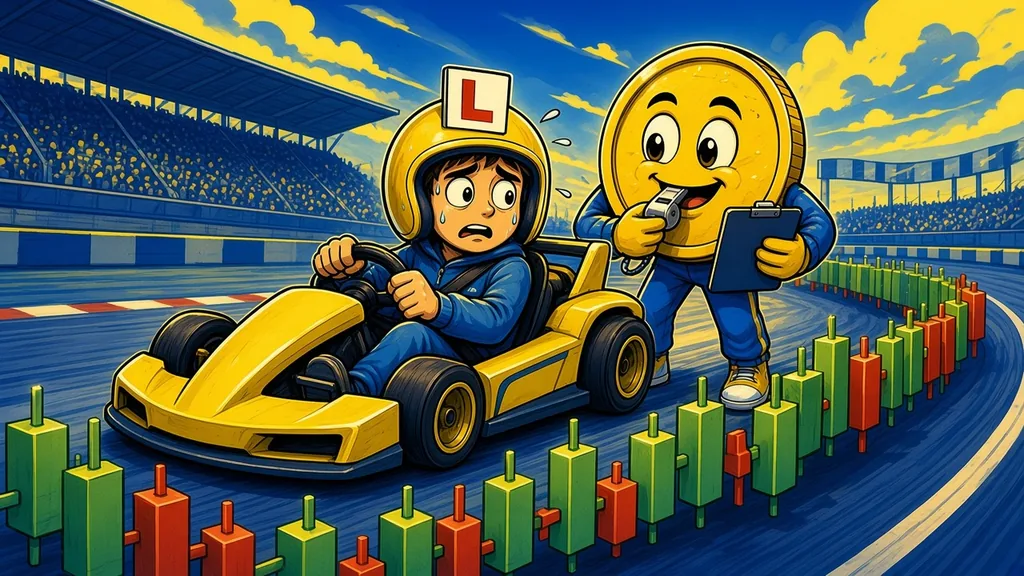

Crypto trading vs investing is one of the first questions new members ask us: "Should I be investing or trading?" Most people want both. They want long-term wealth and they want to know when to buy and sell. That is a fair goal. But investing and trading are different skills with different rules and different tax and fee math. Mixing them up is one of the most common ways beginners get hurt. We have taught both at CCF since 2017. Here is how we break it down with a side-by-side table and a quick quiz at the end.
Crypto investing vs trading: the short version
Investing is buying assets you have researched and holding them for the long term because you believe in where they are going over years and not days.
Trading is taking shorter-term positions based on price structure with a defined entry and a defined exit and a defined amount you are willing to lose.
Neither is better. They are different tools. The problem starts when you use one with the rules of the other.
Side-by-side comparison
| Crypto investing | Crypto trading | |
|---|---|---|
| Time horizon | Months to years | Minutes to weeks |
| Decisions | Few and researched | Many and planned in advance |
| Screen time | Low after the research | Regular and focused |
| Main analysis | Fundamentals, cycles, security | Market structure, key levels, risk-to-reward |
| Main risk | Holding a weak asset too long | Overtrading, oversizing, leverage |
| Emotional pressure | Sitting still through volatility | Following rules in real time |
| Fees | A few trades so a few fees | Fees on every entry and exit |
| US tax treatment | Can qualify as long-term after more than one year | Usually short-term and taxed as ordinary income |
| Record keeping | Light | Heavy: every trade is a reportable event |
| Good first step | A written thesis and a secure wallet | A written trade plan and a journal |
Time horizon examples (hypothetical)
Time horizon is the clearest line between the two. The three profiles below are hypothetical examples to show how different the day-to-day looks. The numbers are made up for illustration. They are not results and not a forecast.
| Long-term investor | Swing trader | Day trader | |
|---|---|---|---|
| Hypothetical setup | Buys $250 on the 1st of each month for 24 months. That is $6,000 put in. | $5,000 account. Holds a few days to a few weeks. Risks 1% ($50) per trade. | $5,000 account. In and out the same day. Risks 1% ($50) per trade. |
| Trades per year | 12 buys | About 36 (3 a month) | About 1,200 (5 a day on 20 days a month) |
| Time commitment | About 1 hour a month plus a quarterly review | 30 to 60 minutes a day | Hours of focused screen time every day |
| Skill that matters most | Patience and security | Planning and risk control | Speed and strict discipline |
| Likely US tax bucket | Long-term on lots held more than one year | Short-term | Short-term |
Notice what is missing: nothing in the table promises a return. Time horizon changes how much work and cost a strategy needs. It does not change the fact that every approach can lose money.
What crypto investing looks like
Investing is our specialty at CCF. Done properly it is quieter than most people expect.
- Research first. You understand what an asset is and what it is for and who is behind it and what could make it fail before you put money in.
- Understand cycles. Crypto moves in market cycles. Prices can run hard in bull markets and fall hard in bear markets. A long-term investor plans for both instead of being surprised by either.
- Spread your risk. Putting everything into one asset puts all your eggs in one basket. Diversifying across a few researched positions means one bad outcome does not wipe you out.
- Security matters. Long-term holdings belong in storage you control and understand with your recovery phrase stored offline and never shared. For many people that means learning how a hardware wallet works.
- Time horizon. You measure progress in years. Daily price moves are noise you learn to ignore.
Dollar-cost averaging (DCA)
Many long-term investors use dollar-cost averaging: investing a fixed amount on a regular schedule instead of trying to time one perfect entry. The SEC's investor education site explains how dollar-cost averaging works. It does not prevent losses but it removes some of the pressure to guess the bottom and builds a steady habit.
Writing an investment thesis
Before you buy a long-term position write three or four sentences: why you own it and what you expect to happen over years and what would prove you wrong and when you will review it. If you cannot write it you are not ready to hold it through a bad month.
The hardest part of investing is not picking. It is sitting still when the market is loud.
New here? Get the free CCF Quick Start Guide for the security and first-buy checklists we teach first.
What crypto trading looks like
Trading is a skill you practice and not a feeling you follow. A real trade has a plan before you click buy:
- A reason to enter based on structure like key levels where price has reacted before.
- An invalidation point, the level where your idea is wrong and you get out, usually with a stop loss.
- A target where you take profit so the risk you take is worth the potential reward.
- A position size that limits your loss to a small planned amount of your account if the trade fails.
Trading has more decisions and more screen time and more emotional pressure than investing. It rewards discipline and punishes improvisation. If you do not have rules you actually follow you are not trading yet. You are guessing. Our guide to crypto risk management for beginners walks through position sizing and stop losses step by step.
Worked trade example (hypothetical)
Here is how a planned trade looks on paper. All numbers are hypothetical.
- Account: $5,000. Risk per trade: 1% = $50.
- Entry: $100. Stop: $95. The stop distance is 5%.
- Position size: $50 ÷ 0.05 = $1,000 (10 units).
- If the stop is hit you lose about $50. If price reaches a $110 target you make about $100. That is a 2-to-1 reward-to-risk plan.
- Fees matter. At 0.80% per side on $1,000 a round trip costs about $16. That is nearly a third of the $50 you planned to risk. Our guide to how to calculate position size in crypto shows how to build fees into the math.
You can run your own numbers with the free CCF position size calculator.
Spot trading vs leverage
Spot trading means buying the actual asset with your own money. Leveraged products (margin, futures, perpetuals) let you control a larger position than your account. They also magnify losses and losses can exceed what you put in. For beginners learn trading on spot first.
The mistake that catches most beginners
Here is the pattern we see over and over. Someone buys a coin as a "trade" because it is moving fast. It drops. Instead of following a plan and taking a small loss they say "I'll just hold it long term." Now a trade they never researched has become an investment by accident and it is sitting in their portfolio for the wrong reason.
The reverse happens too. Someone buys a long-term position they believe in and then watches every candle and sells in a panic on a normal pullback. They used trading emotions on an investing decision.
The fix is simple to say and hard to do: decide which one it is before you buy and follow the rules for that one. Write it down. "This is a long-term investment and I am holding through volatility and I will review my thesis every quarter." Or: "This is a trade and my stop is here and my target is here and I am risking this much."
Fees and costs: investing vs trading
Every buy and every sell can carry a trading fee plus a spread. One trade costs little. Ninety-six trades cost a lot. Here is a hypothetical comparison using the entry-level spot fee tier published on Kraken's fee schedule as of Nov 4, 2026: 0.40% for makers and 0.80% for takers. We use it as an example only. Fees differ by exchange and by account and they change.
Assumptions: a $5,000 position on every trade and 0.80% on each side and no spread or slippage.
| Investor (hypothetical) | Active trader (hypothetical) | |
|---|---|---|
| Activity | 1 buy and 1 sell | 4 round trips a month for 12 months |
| Number of trades | 2 | 96 |
| Fee per trade at 0.80% | $40 | $40 |
| Total fees at 0.80% | $80 (1.6% of $5,000) | $3,840 (76.8% of $5,000) |
| Total fees at 0.40% (maker orders) | $40 | $1,920 |
The point is not that trading is a bad idea. The point is that a trader must earn back the fees on every round trip before making a cent. Spreads and network or withdrawal fees come on top. Read our guide to maker and taker fees in crypto to see how to pay the lower rate.
Time is the other cost. Trading takes regular and focused hours. Investing takes research up front and patience after.
US taxes: short-term vs long-term and Form 1099-DA
For US tax purposes the IRS treats digital assets as property and not currency. When you sell or dispose of a digital asset you held as a capital asset you have a capital gain or loss. How long you held it decides which kind.
- Short-term: held one year or less. Net short-term gains are taxed as ordinary income at graduated rates.
- Long-term: held more than one year. A lower rate can apply to net long-term gains.
The IRS explains both in Topic no. 409, Capital gains and losses. It lists the long-term rates for the 2025 tax year as 0% for single filers with taxable income up to $48,350 and 15% above that up to $533,400 and 20% above that. Those thresholds are updated every year so check the current table when you file.
| Short-term | Long-term | |
|---|---|---|
| Holding period | One year or less | More than one year |
| Federal rate | Ordinary income rates | 0%, 15% or 20% depending on income |
| Typical for | Most trading | Buy-and-hold investing |
| Hypothetical $4,000 gain | $960 tax at an assumed 24% ordinary rate | $600 tax at an assumed 15% rate |
The $4,000 gain and both rates in the last row are hypothetical assumptions to show the size of the gap ($360 here). Your own rate depends on your income and filing status. The IRS notes that holding time is counted from the day after you acquired the asset through the day you disposed of it.
Other tax points that matter for traders
- Swaps count. The IRS lists disposing of one digital asset for another as a transaction you answer "Yes" about on your return. Every swap is an event to record.
- Report everything. The IRS says if you have digital asset transactions you must report them whether or not they result in a taxable gain or loss. Most sales go on Form 8949 and then Schedule D.
- Losses. Capital losses first offset capital gains. If losses exceed gains the IRS allows up to $3,000 ($1,500 if married filing separately) against other income each year with the rest carried forward.
What Form 1099-DA changes
Form 1099-DA is the new broker form for digital asset sales. Under the IRS broker rules custodial platforms must report gross proceeds for transactions on or after Jan. 1, 2025 and must report cost basis on certain transactions on or after Jan. 1, 2026. The rules do not cover non-custodial brokers that never take possession of your assets so you still need your own records. See the IRS page About Form 1099-DA for the latest forms and instructions.
For active traders this means the IRS will see far more of your activity than before. For long-term investors it means the form from your platform should make year-end reporting simpler. Either way keep your own records. Our guide on whether you pay crypto taxes if you do not sell covers the other common questions. This is education and not tax advice. Talk to a qualified tax professional about your situation.
Which should a beginner start with?
For most beginners we suggest building an investing foundation first.
Investing teaches the fundamentals you will need no matter what: how to research and how to store assets securely and how to avoid scams and how market cycles work and how to manage your own emotions when prices swing. It also asks for less screen time which matters if you have a job and a family.
Trading can come next and it should be deliberate. Learn the structure. Learn risk rules. Practice with small size while you build a track record in a journal. Many people end up doing both: a long-term core they rarely touch and a smaller and clearly separated amount they actively trade with strict rules.
Ask yourself three honest questions:
- How much time do I actually have?
- How do I handle watching money go up and down? If every swing keeps you up at night then active trading will be a hard road.
- Do I have rules I will follow when it hurts? If not start by building them, ideally with people who will hold you to them.
A simple way to run both
- Separate the money. Keep long-term holdings and trading funds in clearly separate places.
- Separate the rules. Investments get a thesis and a review date. Trades get a stop and a target and a fixed amount at risk.
- Separate the scorecard. Judge investments over years and trades over a large number of planned trades and not one result.
Quick quiz: investing or trading?
Answer these seven questions honestly. Pick A or B for each and count your A answers.
- Time. A: I have a few hours a month. B: I can focus on charts most days.
- Swings. A: I can leave a big drop alone for months. B: I can act on a written plan within minutes.
- Rules. A: I prefer a few big decisions and a quarterly review. B: I will follow a written stop and target every time even when it hurts.
- Records. A: I want as few transactions as possible to track at tax time. B: I am fine logging every trade in a journal.
- Goal. A: Build a position over years. B: Practice a skill with a small planned amount.
- Money. A: This is money I will not need for years. B: This is a small separate amount I can afford to lose.
- Experience. A: I am brand new. B: I have paper traded for at least two weeks with a written plan.
| Your A answers | What it suggests |
|---|---|
| 6 or 7 | Start with investing. Write a thesis and set up a DCA schedule and secure your storage. |
| 3 to 5 | Investing core plus a small separate trading amount on spot only with a journal. |
| 0 to 2 | Trading may fit your style. Paper trade first and keep size small and never use leverage while learning. |
This quiz is a thinking tool and not advice. It cannot know your finances. If you are still deciding whether crypto belongs in your plan at all read is crypto worth investing in first.
Crypto vs funds: where ETPs fit
Some people want crypto exposure without holding coins directly. The SEC's investor bulletin on spot bitcoin and ether ETPs explains the trade-offs. These are the points that matter for the investing vs trading choice:
- What they hold. Spot bitcoin and ether ETPs hold the crypto asset itself and trade on national securities exchanges.
- What they remove. They may spare you from using a crypto trading platform or wallet and handling keys. The ETP itself is still subject to those risks.
- What they add. Spot ETPs generally pay a sponsor fee that direct holders do not pay. The SEC notes each payment reduces the amount of crypto behind your shares.
- What they do not change. The SEC calls bitcoin and ether highly speculative and says ETP share prices can deviate from the underlying price. Spot ETPs are also not registered under the Investment Company Act of 1940 like ETFs and mutual funds.
Funds suit the buy-and-hold side more than the trading side. Whichever route you choose decide what share of your wider plan digital assets get and write it down. The SEC says to consider how any investment fits into your overall plan.
How AI fits into both
At CCF we teach a third discipline alongside the other two: using AI as an assistant. For investing AI helps you research faster and summarize documentation and list the risks you might be ignoring. For trading it helps you check your position size math and write your plan and review your journal for patterns. In both cases it supports your judgment. It does not replace it and it does not predict prices. See how to use AI for crypto trading for prompts you can use today.
Many long-term investors now hold Bitcoin through ETFs. Learn what crypto ETF outflows really mean before you react to the headlines.
Ready to start the investing side? Our guide to crypto investing for beginners shows how to build a written long-term plan step by step.
Leaning toward investing? Learn how dollar-cost averaging crypto works and when to use it with worked examples and a setup checklist.
Leaning toward trading? Read how to choose a crypto trading course before you pay anyone and how to research a crypto project before you buy for the checklist every investor needs.
Frequently asked questions
Is crypto investing safer than trading?
Neither is safe in the sense of guaranteed. Both carry real risk including losing money. Investing usually involves fewer decisions and less emotional pressure which is why many beginners start there but a poorly researched long-term position can still lose most or all of its value.
Is day trading crypto good for beginners?
Day trading demands the most screen time and the fastest decisions and the strictest discipline so it is usually the hardest place to start. Most beginners learn more by building an investing foundation and practicing trading with small and planned positions.
Can I invest and trade crypto at the same time?
Yes and many people do. The key is keeping them separate: different amounts and different rules and a clear label on every position so you always know which game you are playing.
How much money do I need to start?
There is no required amount. Start with an amount you can genuinely afford to lose while you learn. Learning the process with small amounts is far better than learning expensive lessons with large ones.
What is dollar-cost averaging in crypto?
Dollar-cost averaging means investing a fixed amount on a regular schedule regardless of price. It reduces the pressure to time the market but it does not guarantee a profit or protect against losses.
Is crypto trading taxed differently than investing in the US?
The IRS uses the same capital gains system for both but the holding period changes the rate. Gains on assets held one year or less are short-term and taxed as ordinary income. Gains on assets held more than one year are long-term and can qualify for 0% or 15% or 20% rates. Because traders usually sell within a year most of their gains are short-term. This is general education and not tax advice.
How long do I have to hold crypto for long-term tax treatment?
More than one year. The IRS counts from the day after you acquired it through the day you sell. Each purchase has its own holding period so a DCA buyer can have some lots that qualify as long-term and others that do not yet.
Will I get a Form 1099-DA?
If you sell through a custodial platform that counts as a broker you should receive Form 1099-DA. Brokers must report gross proceeds for transactions on or after Jan. 1, 2025 and basis for certain transactions on or after Jan. 1, 2026. Non-custodial activity is not covered by the broker rules so you still need to track and report it yourself.
Is a crypto ETP better than buying coins directly?
Neither is better for everyone. The SEC says spot bitcoin and ether ETPs may spare you from handling a wallet and keys but they charge a sponsor fee and their prices can deviate from the underlying asset. Both are highly speculative. Match the choice to your goals and your risk tolerance.
Combined, done properly
The goal is not to pick a side forever. It is to understand both skills well enough to use each one on purpose. Trading skill and investing discipline and AI working together. That is the CCF approach and you stay in control the whole way.
The CCF programs page shows the CCF Investing Blueprint and CCF Trading Blueprint when you are ready for more.
Free Quick Start Guide
Want more like this?
Get the free CCF Quick Start Guide. Security and first-buy checklists, chart basics, the 1% risk rule and paper trading in one 42-page PDF.
Education only, not financial advice. We never share your details.
Prefer to talk? Book a call
Written by

CCF · Co-founder
Joshua Montoya is a bestselling author and speaker and an equal co-founder of CCF with Marty Cooney. His story is from fast food to freedom: he left fast food for a digital marketing career in 2010 and has been in crypto since 2017. His mission is the power of 1% and he teaches everyday people to buy, sell, trade and secure digital assets with risk management and independent decisions first.

CCF · Co-founder
Marty Cooney is a bestselling author and speaker and an equal co-founder of CCF with Joshua Montoya. His story is from digital publishing to digital assets: he built a career in online marketing and publishing and has been in crypto since 2017. His motto is show up daily and stack your 1% and he teaches everyday people to buy, sell, trade and secure digital assets with a clear process first.
Educational content only. This article is general education about digital assets, trading and investing. It is not individualized financial, investment, legal or tax advice, and it is not a recommendation to buy or sell any asset. Crypto markets are volatile and involve risk, including loss of principal; leveraged products can lose more than the amount committed. CCF does not guarantee any outcome or return. Do your own research and consider speaking with a licensed professional about your situation.